
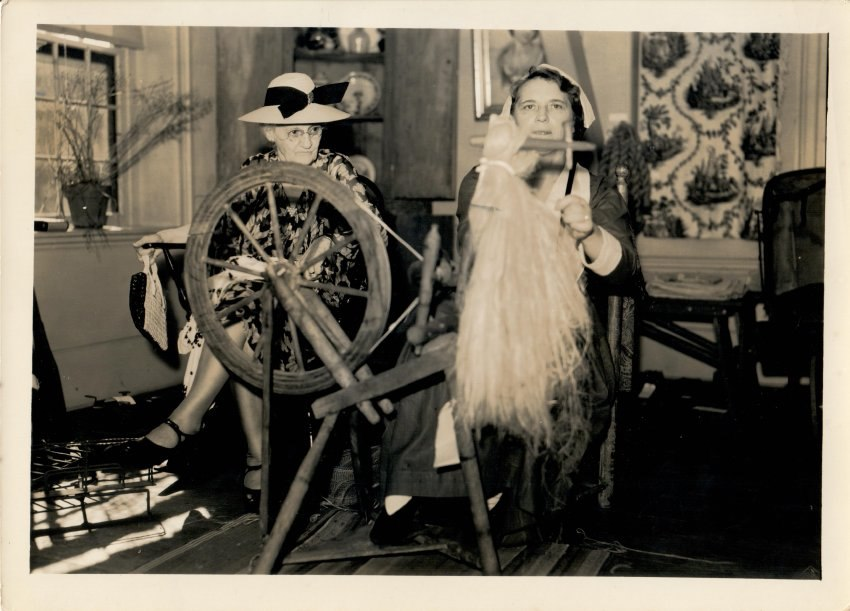
During “Forefather’s Day” at Clinton Academy in 1940, Sybel Dominy Mulford (pictured here) demonstrated how to use a flax wheel. At the History Festival on Mulford Farm next month, we’re thrilled that Fen Youmans, a descendent of David and Phebe Mulford, will demonstrate flax spinning again. Flax, which was commonly grown on Mulford Farm, was an important crop. It provided residents with a local source of fiber for making linen, which was used for clothing, bedding, and other household items. Growing flax during the American Revolution helped East Hampton and other communities become less dependent on imported cloth and allowed families to produce many of their own textiles.
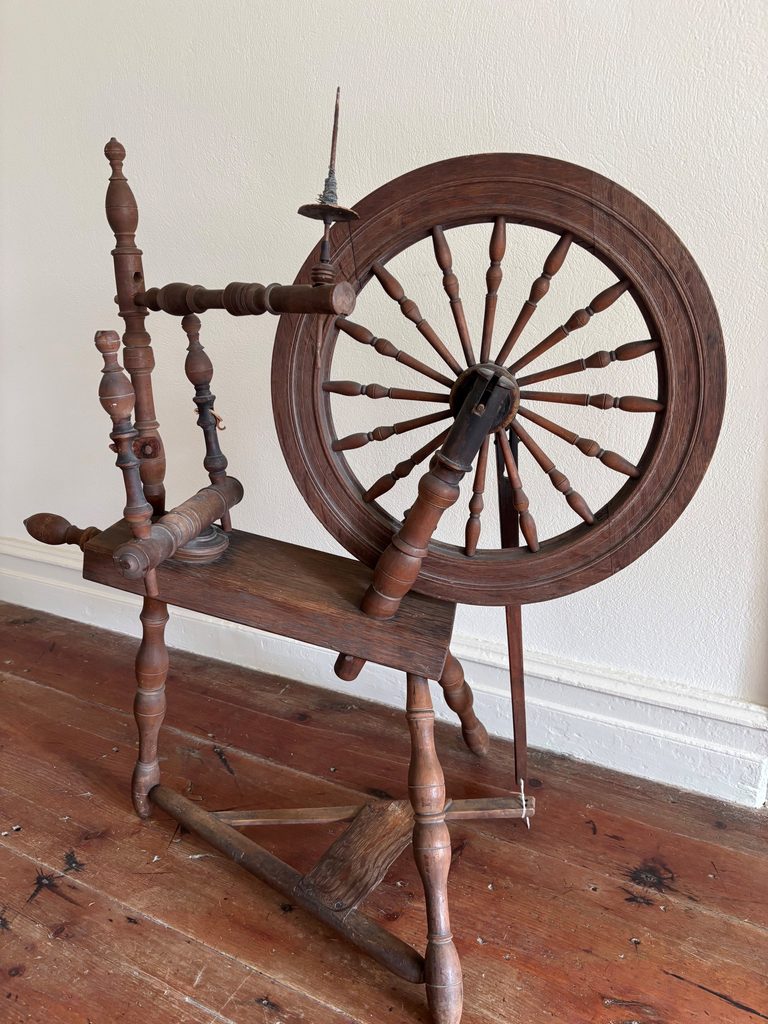
A flax wheel in colonial and early America was used to turn prepared flax fibers into thread that could be woven into linen cloth. Markedly different from a wool spinning wheel, the flax wheel used a pedal and required the spinner to sit next to it. A wool wheel was operated by hand while standing and walking. After flax plants were harvested, retted, dried, broken, and combed to separate the fibers, the long fibers were placed on the wheel’s distaff. The spinner used the foot pedal to turn the large wheel, which rotated a smaller spindle. As the wheel turned, the spinner carefully pulled and twisted the flax fibers, creating a strong, thin thread that was wound onto the spindle. This thread was then woven on a loom – like the one at Mulford Farm – to make linen. While weaving was considered men’s work in the 18th century, spinning flax was the responsibility of women and girls in the household. Join us for a tour of the Mulford Farmhouse and you can see the flax wheel on display in the East parlor.